
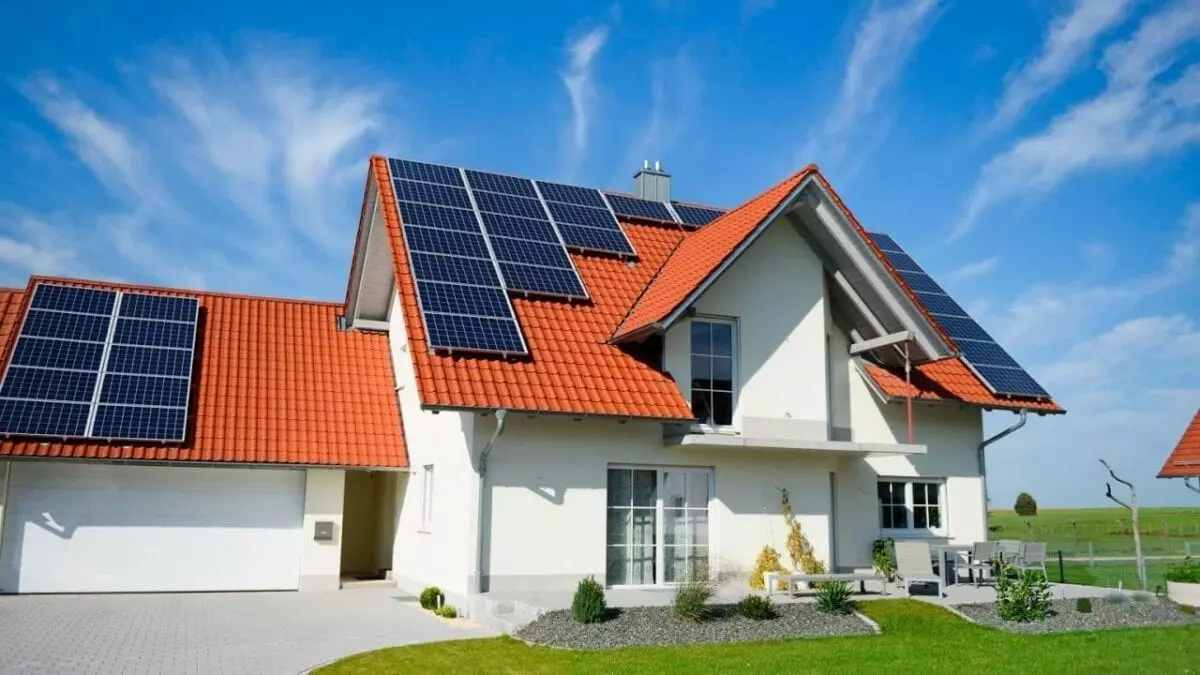
As the efficiency of solar panels increases and the costs for both production and installation reduce at an exponential rate, solar energy will provide for an increasing proportion of energy needs. In some cases, the whole of a home’s needs may be catered for thanks to solar panels.
The concept of a solar-powered home is not new, and indeed the very first example of a solar home was described by Popular Science Magazine as more important than the atomic bomb in 1949.
Through its successes and failures, the Dover Sun House inspired and guided solar engineers for decades afterwards and its legacy still lingers to this day.
Making A Sun House A Sun Home
The construction of the Dover Sun House starts with Mária Telkes, a naturalised American inventor who specialised in biophysics and moved from her home in Budapest (then part of the Austro-Hungarian Empire) at the age of 24 and started to become a specialist in bioenergy and solar energy systems.
She developed the first practical solar heating system, a solar distillation device that could make seawater drinkable through evaporation and started to research the potential for phase-change materials to be used as an energy-storage system before the concept of solar batteries became more widespread.
The first ever solar-heated house, Solar I at the Massachusetts Institute of Technology (MIT), used solar radiation as a source, but it was difficult to generate enough heat in winter with solar collection systems not sophisticated enough to generate enough heat in colder weather.
Professor Telkes was part of the Solar II project initially, but there were disagreements between the chairman of the solar energy fund at MIT Hoyt C. Hottell and herself, largely due to the latter’s scepticism of the potential of solar power compared to a woman later dubbed The Sun Queen due not only to her pioneering inventiveness but her solar evangelism.
The tragic irony was that Mr Hottel was part of the Solar I project, but assumed fossil fuels were effectively unlimited and took funding from corporate sponsors and government groups that sat at odds with solar power.
Eventually, Professor Telkes was taken off the project and reassigned to metallurgy. The last straw was difficulties with implementing her solution of using sodium sulphate (or Glauber’s salt) as a phase-change material to essentially store heat.
She would get another opportunity to explore her ideas with the help of architect Eleanor Raymond and philanthropic benefactor Amelia Peabody.
The Dover Sun House took full advantage of Professor Telkes’ Glauber’s salt solution, using the heat during the day to warm and melt the salt as well as power fans and ducts to bring warm air away from the house’s rooms and towards the heating system.
At night, when the temperature cooled down, the salt solidified, releasing the heat back through the house.
It worked fantastically and proved the potential for solar energy to be harvested, but the problem was that the system had created layers of solid and liquid material that were not mixing properly and thus had clogged up the system. It lasted three years and was replaced by heating oil.
Professor Telkes was fired by MIT in 1953 but spent the rest of her life developing solar technology, including a realisation of her initial ambition in 1981.
What is a Solar-Powered House?
A solar-powered house uses solar panels to turn sunlight into electricity. This energy is used to power lights, appliances, and other devices in the home.
How Does It Work?
Solar panels on the roof collect sunlight. The energy goes through a device called an inverter, which changes it into power the house can use.
Benefits of a Solar-Powered House
It helps save money on electricity bills, lowers pollution, and uses clean energy that doesn’t run out.
Can It Work on Cloudy Days?
Yes, solar panels still work on cloudy days, just not as strongly. The house can also use stored power from batteries or the main power grid when needed.
Is It a Good Investment?
Over time, a solar-powered house can save a lot of money and add value to the home, making it a smart and eco-friendly choice.